
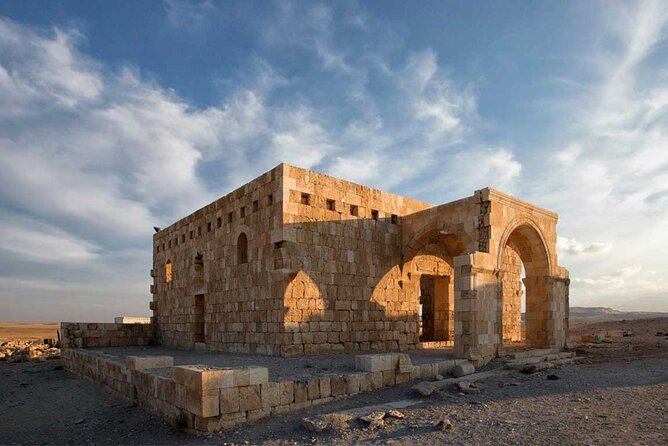
Reviewed · DESERT CASTLES TOURS
5-Desert Castles of Jordan Full-Day Private Tour from Amman
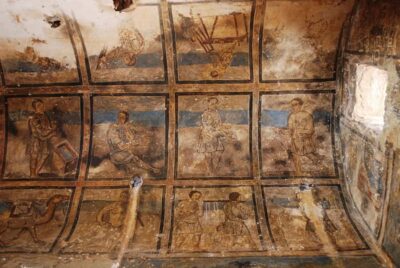
Jordan’s desert castles are not grand palaces in the usual sense. They are isolated Umayyad-era forts, hunting lodges, bathhouses, and country estates scattered across the eastern desert. The most memorable stop is Qusayr Amra, where early Islamic wall paintings show courtly life, animals, and bathing scenes inside a small stone building.
I like the private vehicle, since the sites are spread far beyond Amman and the drives would be tiring in a crowded group. I also like the choice of a three-castle route or a longer five-site day, plus Wi-Fi and water in the car. The catch is that entry fees are extra, and the service can depend heavily on which driver you receive. Most reports describe friendly drivers such as Jehad, Jaber, Ebrahim, and Esam, but one serious complaint described a driver who spoke little English and provided neither water nor Wi-Fi.
In This Review
- Key points to know before booking
- Why Jordan’s desert castles are worth a day
- The three-castle route from Amman
- Qusayr Amra and its painted bathhouse
- Qasr Kharana, the mysterious square fortress
- Qasr al-Azraq and the oasis
- Adding Hallabat and Umm al Jimal
- Qasr al-Hallabat and its Roman foundations
- Umm al Jimal and a ruined basalt city
- What the private vehicle adds to the experience
- Price, admissions, and the real value
- Who should book this desert castle trip
- Cancellation and booking details
- Should you book the Jordan desert castles tour?
- FAQ
- How long does the private desert castles tour take?
- Which castles are included in the standard route?
- Can I visit five sites instead of three?
- Is transportation private?
- Is an English-speaking driver included?
- Are Wi-Fi and water included?
- Are admission fees included in the price?
Key points to know before booking
- Qusayr Amra is the star stop: Its unusual secular paintings and old bathhouse make it much more than a ruined fort.
- You can choose three or five sites: The shorter circuit visits Amra, Kharana, and Azraq. The longer option adds Hallabat and Umm al Jimal.
- The private setup matters: Your group has its own air-conditioned vehicle, rather than sharing a bus and fixed seating.
- The day is drive-heavy: Each main stop receives about an hour, but the sites are widely separated across eastern Jordan.
- Wi-Fi and bottled water are included: These are useful extras on a long desert road day, though you should confirm they are available at pickup.
- Bring extra money for admissions and tips: Entrance fees are not included, and driver gratuities are strongly encouraged.
Why Jordan’s desert castles are worth a day
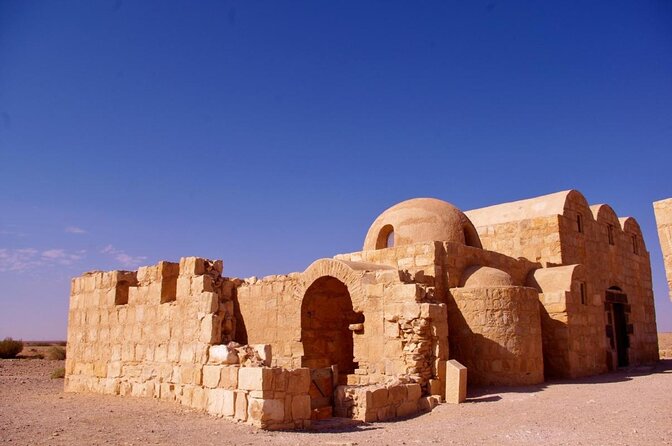
The phrase desert castle can set the wrong expectation. You will not find five complete medieval fortresses with towers, furnishings, and intact royal rooms. Instead, you get a chain of archaeological sites that reveal how rulers used the eastern desert in the first centuries of Islam.
The Umayyads built many of these places in the seventh and eighth centuries. Some served military purposes. Others were estates, hunting retreats, bathhouses, or stopping points along routes through a difficult, dry region. Their isolation is part of the appeal. You leave Amman’s traffic behind and spend much of the day with open desert, dark basalt stone, and broad views.
I would not make this your first Jordan sightseeing day if you have not yet seen Amman, Petra, or the country’s more famous Roman and Nabataean sites. But after those major stops, this outing gives you a quieter side of Jordan. It is also a smart choice if you have a spare day in Amman and want a private trip without arranging a rental car.
More desert castles tours in Amman:
- From Amman: Umayyad Desert Castles Tour with Transfer
★ 4.5 · 69 reviews - From Amman: Desert Castles of Eastern Jordan Tour
★ 4.8 · 53 reviews - From Amman: Full-Day tour Amman city tour and desert castles
★ 5.0 · 23 reviews
The three-castle route from Amman
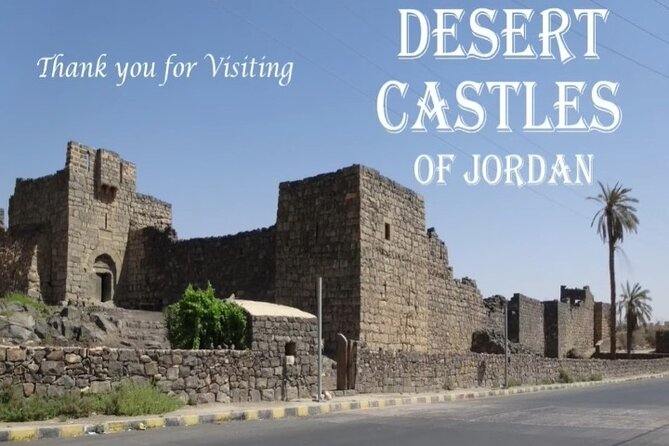
The core route takes in Qusayr Amra, Qasr Kharana, and Qasr al-Azraq. The listed time is about seven to eight hours, including the long transfers, with roughly one hour at each main site.
That timing is sensible for a first visit. You will have enough time to walk around each location, take photos, and hear an explanation from the driver. It is not enough time for a slow archaeological study, an extended picnic, or lingering at every ruined wall.
Qusayr Amra and its painted bathhouse
Qusayr Amra, also written Qasr Amra or Quseir Amra, is the most distinctive stop. Built by the Umayyads in the eighth century, it began as a fortress and residence but became known as a pleasure palace. It included a hammam, or bathhouse, and its walls were decorated with paintings that show secular scenes rather than only religious subjects.
That detail makes the site special. You can see how early Islamic rulers used art to present power, leisure, hunting, animals, and entertainment. The building is not huge, so the one-hour stop is generally well matched to its scale.
Admission is not included. The site is also the UNESCO-listed part of this route, which gives it extra importance, but do not expect a large museum complex or a long series of rooms. The appeal is concentrated in the surviving structure and its paintings.
I would put Amra first in your expectations. If you care most about art, architecture, and the connection between daily life and royal power, this is the stop that justifies the outing.
Qasr Kharana, the mysterious square fortress
Qasr Kharana is one of Jordan’s best-known desert castles. It sits about 60 kilometers east of Amman, relatively close to the Saudi Arabian border, and has a compact, fortress-like appearance.
The building is often spelled Kharana, Harranah, Kharanah, Kharaneh, or Hraneh. Do not worry if the spelling on your map or ticket looks different. You are looking for the same site.
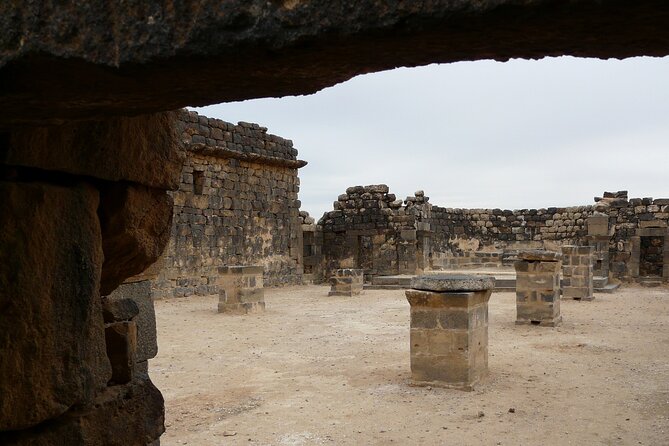
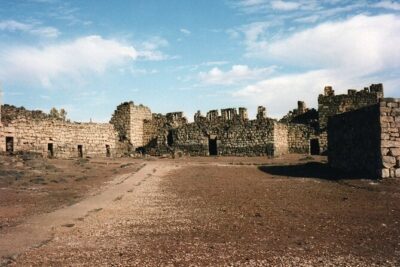
Kharana is useful for understanding the defensive side of the desert castles. Its thick walls and corner towers give it a stronger military feel than Qusayr Amra, though its exact original purpose has been debated. Inside, you can focus on the layout, stonework, and the way a large structure was placed in an otherwise open setting.
The one-hour stop gives you time to see the exterior and explore the interior at an unhurried pace. Still, this is a ruin, not a furnished palace. The enjoyment comes from the shape of the building and the contrast between its formal construction and the empty desert around it.
A few more Amman trips to weigh up
- From Amman: Petra and Wadi rum Full day Tour
★ 5.0 · 538 reviews - Petra Full-Day Private Tour from Amman
★ 4.9 · 392 reviews - Amman Petra Full-Day Trip
★ 5.0 · 270 reviews - From Amman : Full day tour to Petra
★ 5.0 · 250 reviews
Qasr al-Azraq and the oasis
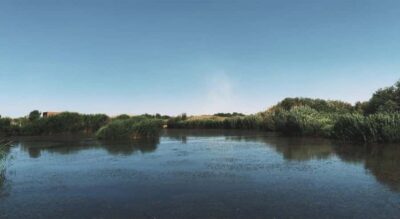
Qasr al-Azraq lies near the modern town of Azraq, roughly 100 kilometers east of Amman. Its location mattered because the nearby oasis was the only reliable water source across a huge desert area.
That water explains why Azraq had strategic value. A fortress placed beside an oasis could control movement, offer protection, and support people and animals crossing the region. The site gives the tour a useful geographic lesson: these castles were not scattered at random. Water and travel routes shaped their position.
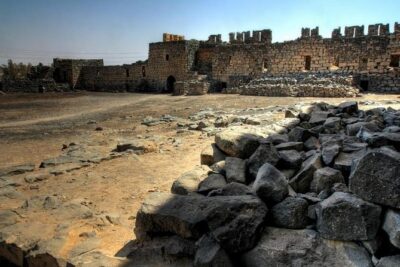
Azraq is a larger fortress than Qusayr Amra. Its dark stone gives it a heavy, sturdy look, and its setting helps you picture the practical problems of crossing eastern Jordan. The stop lasts about an hour, enough for a broad look rather than a specialist examination.
The three-castle route is the better choice if you want the main highlights without turning the day into a long archaeological circuit. It also leaves you with a little more breathing room during the drives.
Adding Hallabat and Umm al Jimal
The upgraded route adds Qasr al-Hallabat and Umm al Jimal. These stops make the day longer in substance, even if the published duration remains about seven to eight hours. You should ask at booking how the five-site version is scheduled, since the extra stops may mean less time at each location or a later return to Amman.
Qasr al-Hallabat and its Roman foundations
Qasr al-Hallabat is a square palace with four towers and a nearby mosque. It was built on the site of an earlier Roman fort, so the stop shows several periods of Jordanian history in one place.
One unusual detail is the presence of Greek inscriptions on 160 basalt blocks. That gives you something specific to look for, rather than simply walking around another pile of stones. The nearby mosque also helps explain how the site changed from a Roman military position into an Umayyad-era complex.
The planned visit is about 45 minutes. That is enough for an overview, but not enough to study every inscription. If you choose the five-site option, you should treat Hallabat as a focused stop, not a full museum visit.
Umm al Jimal and a ruined basalt city
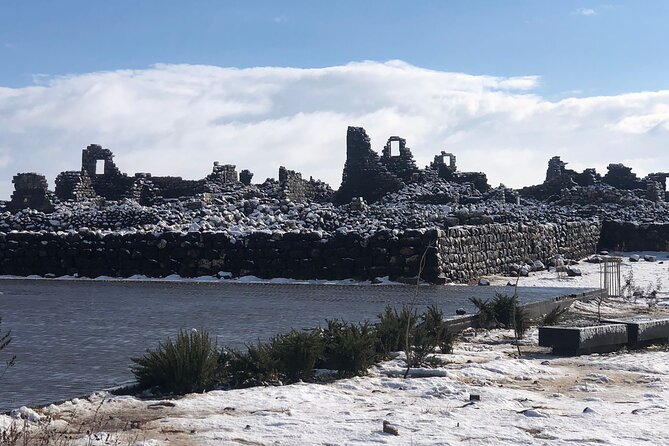
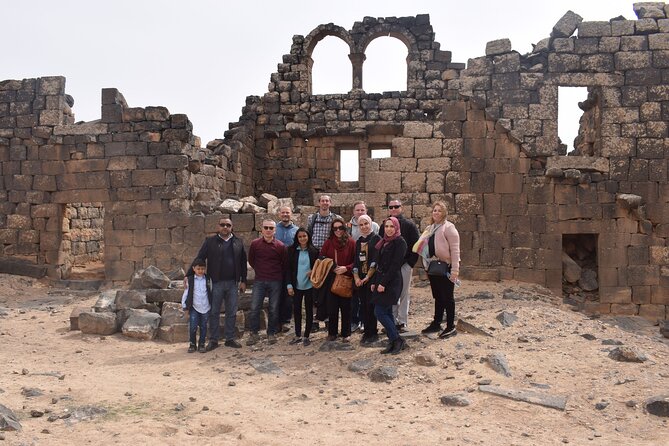
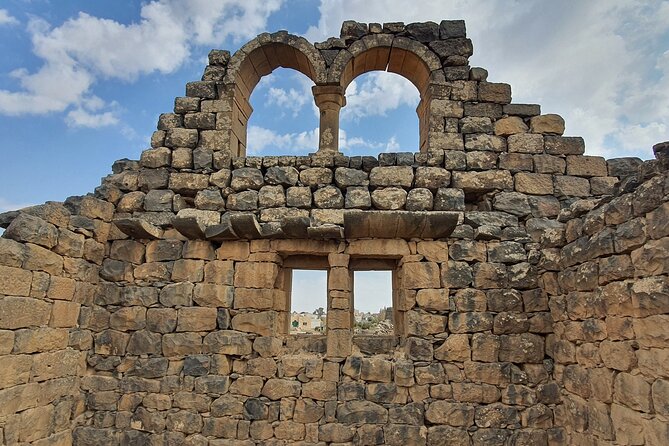
Umm al Jimal is about 17 kilometers east of Mafraq in northern Jordan. Unlike the smaller desert castles, it is a ruined settlement, giving you a broader sense of how people lived and built in this dry region.
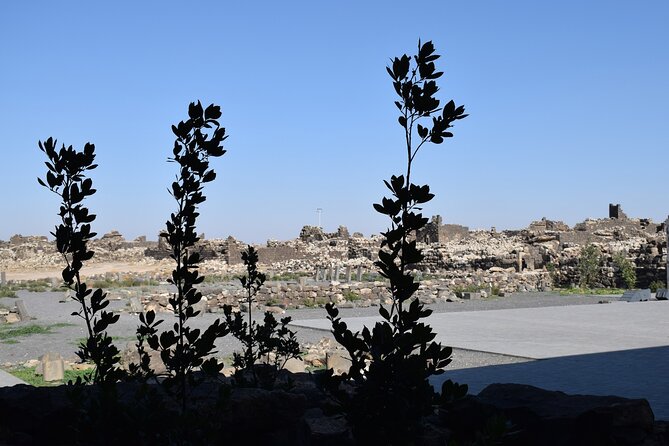
The site is also known by several spellings, including Umm el-Jimal, Umm ej Jemāl, and Umm adj-Djimal. Its dark basalt construction creates a different visual character from the lighter stone buildings farther east.
You receive about 45 minutes here. That is a short visit for a large ruined town, so I would choose the five-site route only if you are genuinely interested in archaeology and old settlements. If you prefer a relaxed day with more time at each castle, the three-site circuit is likely the better fit.
What the private vehicle adds to the experience
The service provides private transportation in a modern, air-conditioned vehicle. Only your group participates, and each person may bring a small or medium-sized bag.
This matters because the tour is not a simple series of nearby stops. You spend a substantial part of the day on the road, crossing open country between sites. A private car gives you room to spread out, control your own conversation, and avoid collecting passengers across Amman.
The vehicle also includes free Wi-Fi and mineral water. Wi-Fi is useful if you need to message family, check maps, or avoid roaming charges. Water is a small extra, but it matters on a long day in dry conditions.
The English-speaking driver is an important part of the value. Several drivers associated with this service, including Jehad, Jaber, Ebrahim, and Esam, have been praised for friendliness, local suggestions, safe driving, and explanations of the sites. Jaber was also credited with recommending a restaurant serving mansaf, Jordan’s famous rice and lamb dish.
Still, you should keep your expectations clear. This is described as transport with an English-speaking driver, not a fully guided archaeological tour with a specialist at every castle. Some drivers may give useful historical context, while others may provide only basic information. One poor experience reported no conversation, no water, and no Wi-Fi, so it is sensible to confirm those inclusions when the vehicle arrives.
Price, admissions, and the real value
The listed price is $139.99 per person. That can be fair for a private full-day trip, especially for two or more people who value a dedicated vehicle and do not want to drive themselves through Amman and the eastern desert.
The price becomes harder to judge for a solo guest, since private transport costs are spread across fewer people. Group discounts are offered, so larger parties may get better value. Ask about the discount before paying rather than assuming it is automatic.
Remember that entry fees are not included. You will also need to budget for a driver tip, which the operator strongly recommends. Pickup or drop-off outside the stated service area may cost extra as well.
For value, compare this with what a rental car, fuel, navigation, and the stress of driving would cost you. The main benefit is not just the seat. It is the convenience of having the long route handled while you look out the window and decide how much attention you want to give each ruin.
Who should book this desert castle trip
I would recommend it to you if you have already seen Jordan’s major attractions and want a quieter day away from Amman. It is also a good match for couples, families, and small groups who want their own schedule and do not want a large coach.
History fans should choose the five-site version, especially if Umm al Jimal and the Greek-inscribed basalt blocks at Hallabat sound appealing. The three-castle route suits you better if Qusayr Amra is the main goal or if you prefer fewer stops and more time at each one.
This is less suitable if you want constant guided commentary, hands-on activities, or a full meal included in the price. The day is mainly transport, walking around ruins, and looking closely at architecture and paintings.
Wear comfortable shoes, carry sun protection, and bring some cash for admissions and tipping. Give the company your WhatsApp number so pickup communication is easier, and confirm your pickup area if you are staying outside the standard zone.
Cancellation and booking details
You receive confirmation at booking, and free cancellation is available up to 24 hours before the local start time. Canceling or changing the reservation within 24 hours does not qualify for a refund.
Service animals are allowed, and most people can take part. Since only your own group participates, you can ask the operator how the five-stop schedule will work for your party before finalizing the booking.
Should you book the Jordan desert castles tour?
Book it if you want a private, practical way to see eastern Jordan and you value comfort during long drives. Qusayr Amra alone is a strong reason to go, while Azraq and Kharana add useful variety in setting and purpose.
Choose the three-castle route for a focused day. Pay for the five-site option if you have a real interest in ruined settlements and early Islamic architecture. The price is reasonable for private transport, Wi-Fi, water, and an English-speaking driver, but only if the service delivers what is promised.
I would confirm the driver’s English, Wi-Fi, water, pickup zone, and exact number of stops before departure. That small check helps protect the value of the day and ensures this remote, rewarding side trip matches what you want from Jordan.
FAQ
How long does the private desert castles tour take?
The experience lasts approximately 7 to 8 hours.
Which castles are included in the standard route?
The three-castle circuit includes Qusayr Amra, Qasr Kharana, and Qasr al-Azraq.
Can I visit five sites instead of three?
Yes. You can add Qasr al-Hallabat and Umm al Jimal to the three-castle route.
Is transportation private?
Yes. The tour uses private transportation, and only your group participates.
Is an English-speaking driver included?
Yes. An English-speaking driver accompanies the trip.
Are Wi-Fi and water included?
Yes. Free Wi-Fi and mineral water are provided onboard the vehicle.
Are admission fees included in the price?
No. Entry fees are not included. Driver gratuities are also separate and highly recommended.
Just added around Amman
- From Amman :Private full day tour to Jerash ,Ajoune and Um Qais★ 5.0 · 12 reviews
- Queen Alia Airport Transfers From / To Amman, Petra, Dead Sea.★ 5.0 · 3 reviews
- 2-Day Private Tour in Jordan – Deluxe Tent★ 5.0 · 9 reviews
- From Amman to West ( Madaba, Mt Nebo, baptism site and dead sea)★ 4.0 · 5 reviews
- Dead Sea Half-Day Tour from Amman★ 5.0 · 8 reviews
- airport pick up & transportations Services★ 5.0 · 15 reviews
- Umm Qais, Ajloun and Jerash Full-Day Tour from Amman★ 5.0 · 4 reviews
- FROM AMMAN | Petra & Wadi Rum in one day | The Jordanian Mappers★ 5.0 · 12 reviews
Desert Castles Tours, compared.
Full-Day tour Amman city tour and desert castles
Read our review →
Private Tour of Desert Castles Eastern Jordan with optional Azraq Wetland Visit
Read our review →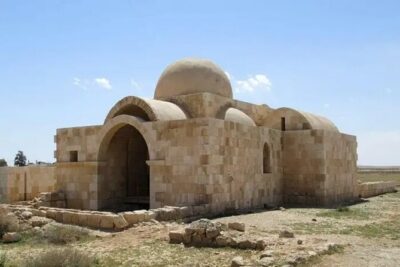
Day Tour To Desert Castles & Cave of the Seven Sleepers
Read our review →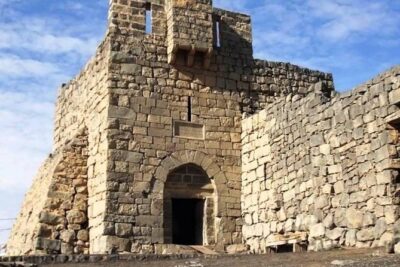
Private Tour: Full-Day Islamic Desert Castles and Ajloun Castle Trip from Amman
Read our review →
Browse the lists this tour appears in