Reviewed · PETRA TOURS
Half-Day Private Indiana Jones Petra Back Road Trial Tour
Petra is at its most dramatic when you approach it from the back. This private horse-riding tour begins at Little Petra, crosses high ground above the rose-colored mountains, and reaches the Monastery before working back through Petra’s main monuments. You get broad views and quieter ruins before the famous sights appear.
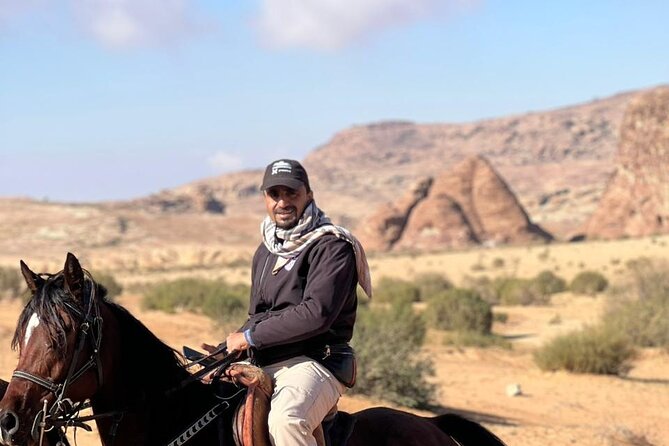
I like the Little Petra to Monastery route, which gives the day a sense of discovery instead of simply following Petra’s busiest central path. I also like the private format and the care given to the horses. Mohammed, the horseman connected with this experience, is described as attentive about safety, comfort, and the animals’ behavior.
The main consideration is the physical demand. You need moderate fitness, and reaching the Monastery still means climbing about 800 rock-cut steps, usually taking around 45 minutes on foot. The Petra entry ticket also costs extra, at 50 JD, so the real price is higher than the tour charge alone.
In This Review
- Key points to know before booking
- Starting at Petra Visitor Center at 8:00 am
- Little Petra and Asiq Al Barid: a quiet opening
- Reaching the Monastery by the long stairway
- Returning through Petra’s central monuments
- Seeing the Treasury without losing the wider story
- Horse handling, safety, and comfort
- Is $165 per person good value?
- Who should book this Petra route?
- Should you book the Indiana Jones Petra back route?
- FAQ
- Where does the tour start?
- How long does the experience last?
- Is the Petra entry ticket included?
- What is included in the tour price?
- Is this a private tour?
- What fitness level do I need?
Key points to know before booking
- A back-door approach to Petra: Begin at Little Petra and cross the hills before reaching the Monastery.
- High viewpoints: Qararah Park and the Monastery area offer wide views toward Jordan’s mountains and the West Bank.
- Horse riding with walking: The horses help you cover the rugged route, but the Monastery climb and major-site visits involve walking.
- A private experience: Only your own group participates, allowing the pace to suit your group.
- A full half-day: Plan on 5 to 6 hours, starting at 8:00 am at Petra Visitor Center.
- Extra entry cost: The 50 JD Petra admission ticket is not included, while bottled water is included.
Starting at Petra Visitor Center at 8:00 am
You meet at Petra Visitor Center in Wadi Musa at 8:00 am. The tour ends back at the same meeting point, which makes planning easier if you have a hotel, taxi, or later activity in town.
The early start matters in Petra. A half-day here can feel long once you add rough paths, sun, stairs, and repeated stops for photographs. Starting in the morning gives you a better chance of handling the Monastery climb before the strongest heat, though weather still affects the experience. The provider requires good weather and offers another date or a full refund if conditions force a cancellation.
This is a private tour, not a mixed group excursion. That matters on a horse route. You are not tied to the pace of a large party, and the guide can pay closer attention to riding comfort and safety. The tradeoff is price. At $165 per person, this is not a budget way to enter Petra, especially because the 50 JD park ticket is separate. You are paying for a specialized route, private attention, horses, and a longer experience rather than simple admission and a standard walk.
More petra tours in Petra:
- Amman: Petra, Wadi Rum, and Dead Sea 2-Day Tour
★ 4.9 · 1,173 reviews - 2-Day Tour: Petra, Wadi Rum, and Dead Sea from Amman
★ 5.0 · 1,141 reviews - From Amman: Petra & Wadi Rum Private or group Day Tour
★ 4.9 · 750 reviews
Little Petra and Asiq Al Barid: a quiet opening
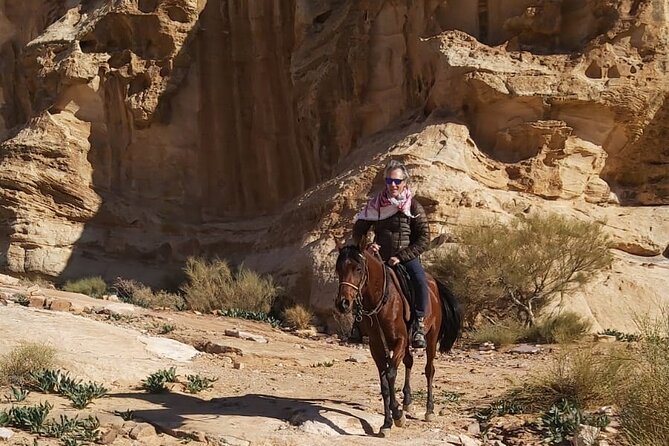
The first section leads through Little Petra, also known as Asiq Al Barid. It is smaller and quieter than the central Petra site, but it gives you a useful introduction to Nabataean life before the day reaches the grand façades.
You pass caves, old villages, and rock-cut spaces. These are not just scenic pauses. They help you see how people used the cliffs for shelter, storage, movement, and daily life. The scale is more intimate here than at the Treasury or Monastery. You can focus on the shape of the rock and the old living spaces without being overwhelmed by Petra’s largest monuments.
The route also passes Qararah Park, a high area with broad views of Petra’s mountains. This is one of the tour’s most appealing features. You are not only moving from one famous site to another. You are seeing the entire setting from above, with the canyon system and surrounding mountains spread out below you.
You then continue along Dabdabah Road toward the Petra Bubble Luxel Resort. The supplied details do not specify how much of this stretch is ridden and how much is walked, so ask Mohammed to explain the riding plan at the start. That is sensible for anyone with limited riding experience or concerns about uneven ground.
Little Petra has a calm feel, and this part of the outing is suited to you if you prefer ancient places with room for silence and thought. It is less suited to anyone who wants to reach Petra’s major monuments as quickly as possible. The first hour and a half is spent around the back route and Little Petra, not at the Treasury.
Reaching the Monastery by the long stairway
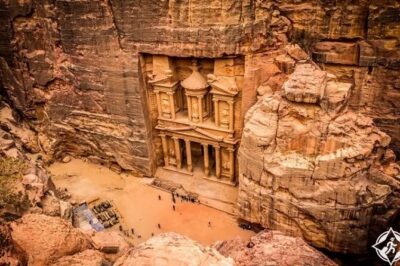
After Little Petra, the route heads toward Ad Deir, the Monastery. This is the day’s major payoff. The building is a huge façade cut from sandstone more than 2,000 years ago, measuring about 58 meters across. It is one of Petra’s largest and most striking monuments.
The name can mislead you. The Monastery was not originally built as a Christian monastery. It was one of two structures in Petra later converted into churches during the Byzantine period. That later use adds another layer to the site, but the first impression is the scale of the carved stone.
You reach it by climbing around 800 steps cut into the rock. The climb generally takes about 45 minutes. It is not a minor walk added between horse rides. It is a real uphill effort, with uneven stone underfoot and little reason to rush. Wear firm shoes, carry water, and keep enough energy for the rest of Petra afterward.
Bottled water is included, but you should still treat the climb seriously. The tour calls for moderate physical fitness, and that description is important. Riding does not remove the demanding parts of Petra. If stairs are difficult for you, the Monastery section may be the deciding factor.
At the top, the view is part of the reward. You see the Monastery against the mountain and look across the wide rock country toward Jordan and the West Bank. The high position changes your sense of Petra. From below, the monuments feel enclosed by cliffs. Here, the area opens out.
Allow yourself time at the Monastery. The façade is large enough that you will want to step back, study the doorway, and compare the smooth carved face with the rough layers around it. The details supplied for the tour do not promise a café, seating, or a fixed refreshment stop, so do not count on a long service break at the top.
Returning through Petra’s central monuments
From the Monastery, the tour continues through Petra’s main historic area. This return section is roughly two hours and shifts from mountain riding and remote views to the famous remains most people associate with Petra.
You see Qasr al-Bint, described here as the Girl Palace, a religious temple at the end of the Colonnaded Street. It survived major earthquakes and gives you a sense of Petra as a functioning city, not just a collection of decorated tombs.
The Colonnaded Street follows a Roman east-west plan. Its surviving columns and ruins once formed a central urban route, with additional structures on either side. Much of Petra is famous for single monuments, but this street helps you picture movement, trade, public life, and the shape of the old city.
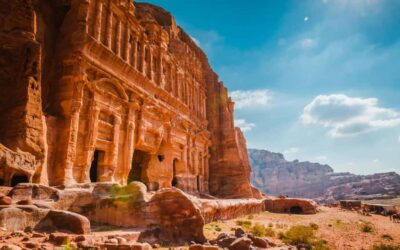
The Royal Tombs are another highlight. They were carved into the rose-red sandstone by the Nabataeans around 2,300 years ago. Their broad fronts are less immediately enclosed than the Treasury, and the changing light across the stone can make them look quite different from one stop to the next.
The route also includes the Byzantine Church, a fifth-century building known for its remains and mosaic work. It reminds you that Petra continued to matter after the Nabataean period. The city was not frozen at the moment of its most famous construction. People used and adapted the area across later centuries.
The exact riding conditions through this central section are not fully described. You should expect a mixture of riding, walking, and close viewing of the monuments. Some places are better seen on foot, especially when you need to move near carved walls, columns, tomb façades, and uneven archaeological remains.
A few more Petra trips to weigh up
- Private Half-Day Tour of Petra with Lunch
★ 4.5 · 46 reviews - Wadi Rum Half-Day Desert Tour | Wadi Rum Desert
★ 5.0 · 86 reviews - Take advantage of a half-day boat dive experience in Red sea of Aqaba.
★ 5.0 · 71 reviews - Amman: Private Half-Day Tour to Madaba & Mount Nebo
★ 4.6 · 46 reviews
Seeing the Treasury without losing the wider story
The Treasury is one of the final major sights mentioned for the return route. It is Petra’s most recognizable façade, so the first view can feel almost too familiar from photographs. In person, its position at the end of the Siq gives it much of its power.
The useful feature of this tour is that the Treasury comes after Little Petra, high viewpoints, the Monastery, and the central ruins. By then, you have already seen Petra as a large mountain city. The Treasury becomes part of that larger picture rather than the entire point of the visit.
You also pass the theater and other major remains. The theater shows the scale of public space in Petra, while the Royal Tombs and Colonnaded Street add different types of evidence about the city. The day is strongest when you pay attention to these contrasts: tombs, temples, streets, churches, theaters, and mountain routes all occupy the same ancient setting.
A horse route can also give you a different view of the valley than a standard out-and-back walk from the main entrance. One older rider, aged 72, described the high valley views as a major benefit because they opened up areas difficult to reach on foot. That does not mean the ride is effortless, but it does show why this option can appeal to people who want wider views without undertaking every approach as a full hike.
Horse handling, safety, and comfort
Mohammed is the named horseman associated with the experience. The practical praise around his role centers on communication, safe handling, and making sure riders are comfortable. The horses are described as well cared for and well behaved, which is important on Petra’s rough ground.
You should still be honest about your own riding ability. A horse that behaves well does not turn rocky mountain paths into a smooth ride. If you are nervous, new to riding, or unsure about the route, tell the guide at the beginning. The private format gives you a better chance to discuss pace and comfort than a large group tour would.
The supplied information also describes a separate horse ride from the entrance toward the Siq and near the Sacrificial Site, using a quiet route with stops at a Bedouin hut and a local shop. Those details help show the kind of personal, less conventional riding experience connected with Petra Horse Ride Adventure, but they are not listed as fixed stops on this specific Little Petra to Monastery route. Do not assume those stops are included here.
Service animals are allowed, and the meeting point is near public transportation. The tour is not described as wheelchair accessible, and the stairs, rocks, and mountain paths make it unsuitable for anyone who cannot manage uneven ground and a long climb.
Is $165 per person good value?
The answer depends on what you want from Petra. If you only want to see the Treasury and leave, $165 per person plus the 50 JD entry ticket is a high outlay. A standard visit may suit you better.
If you want a private route linking Little Petra, high mountain viewpoints, the Monastery, and Petra’s central monuments, the price has a clearer reason. You receive roughly 5 to 6 hours with your own group, horse support on the back route, a guide focused on your party, and a route that covers much more than the usual first look at the Treasury.
The cost also includes bottled water, but not Petra admission. Ask about the exact ticket arrangements before setting out, since the entry fee is a substantial extra cost. The provider confirms your booking at once, and free cancellation is available if you cancel at least 24 hours before the 8:00 am start. Changes or cancellations inside that window are not refunded, and poor weather may lead to a new date or full refund.
Who should book this Petra route?
I would point this tour toward an active visitor who wants a different angle on Petra and does not mind a long morning of movement. It suits you especially well if you like mountain views, ancient routes, private guiding, and the idea of reaching the Monastery through Little Petra instead of treating Petra as a single straight walk.
It may also suit an older or less hiking-focused rider who wants access to wide views by horse, provided that person can still manage the Monastery stairs and rough ground. The 72-year-old rider connected with the experience enjoyed seeing high parts of the valley that would have been hard to reach by ordinary walking.
I would be more cautious if you have limited mobility, dislike horses, want a relaxed sightseeing pace, or are mainly interested in the Treasury. The word half-day can sound gentle, but this is an active half-day with stairs, mountain paths, and several hours of touring.
Should you book the Indiana Jones Petra back route?
Book it if you want Petra’s bigger story: Little Petra’s caves, high ridges, the Monastery, ancient streets, tombs, the theater, the Byzantine Church, and the Treasury. The private setting and horse support add flexibility, while Mohammed’s reported care with the horses is a useful point in its favor.
Skip it if the extra ticket cost strains your budget or if an 800-step climb is beyond your comfort level. Before paying, confirm exactly where you will ride, where you will walk, and how the horses are used between Little Petra and the Monastery. For fit visitors who want Petra beyond the standard postcard view, this is a strong choice.
FAQ
Where does the tour start?
The tour starts at Petra Visitor Center, 28, Wadi Musa, Jordan, at 8:00 am.
How long does the experience last?
The tour lasts approximately 5 to 6 hours.
Is the Petra entry ticket included?
No. The Petra ticket costs 50 JD and is not included in the tour price.
What is included in the tour price?
Bottled water is included. The private tour, horse-riding portions, guide service, and listed route are part of the experience, while Petra admission is separate.
Is this a private tour?
Yes. Only your own group participates in the activity.
What fitness level do I need?
A moderate level of physical fitness is required. Reaching the Monastery involves about 800 rock-cut steps and takes around 45 minutes on foot.
Just added around Petra
- Transfer From Dead Sea To Petra★ 5.0 · 4 reviews
- Private One Day Petra from Dead Sea with Hotel Pickup★ 5.0 · 6 reviews
- Petra Excursion from Dead Sea★ 5.0 · 8 reviews
- Petra Day Tour from Dead Sea★ 5.0 · 6 reviews
- Dead sea to Petra★ 5.0 · 3 reviews
- Petra Private Transfer to or from Dead Sea★ 5.0 · 5 reviews
- Petra Private Guided Tour★ 5.0 · 4 reviews
- From Petra to Wadi Rum, then back to Amman or the airport.★ 5.0 · 16 reviews
Petra Tours, compared.
2-Day Tour: Petra, Wadi Rum, and Dead Sea from Amman
Read our review →
2-Day Petra, Wadi Rum and Dead Sea Tour from Amman
Read our review →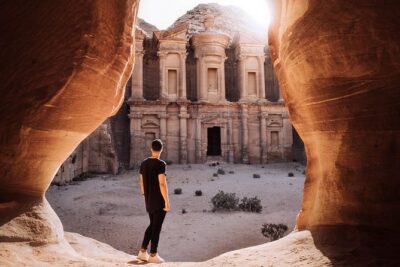
3-Day Private Tour from Amman: Petra, Wadi Rum, Dana, Aqaba, and Dead Sea
Read our review →